
IPL Impact Player Rule: How Substitutions Work in Matches
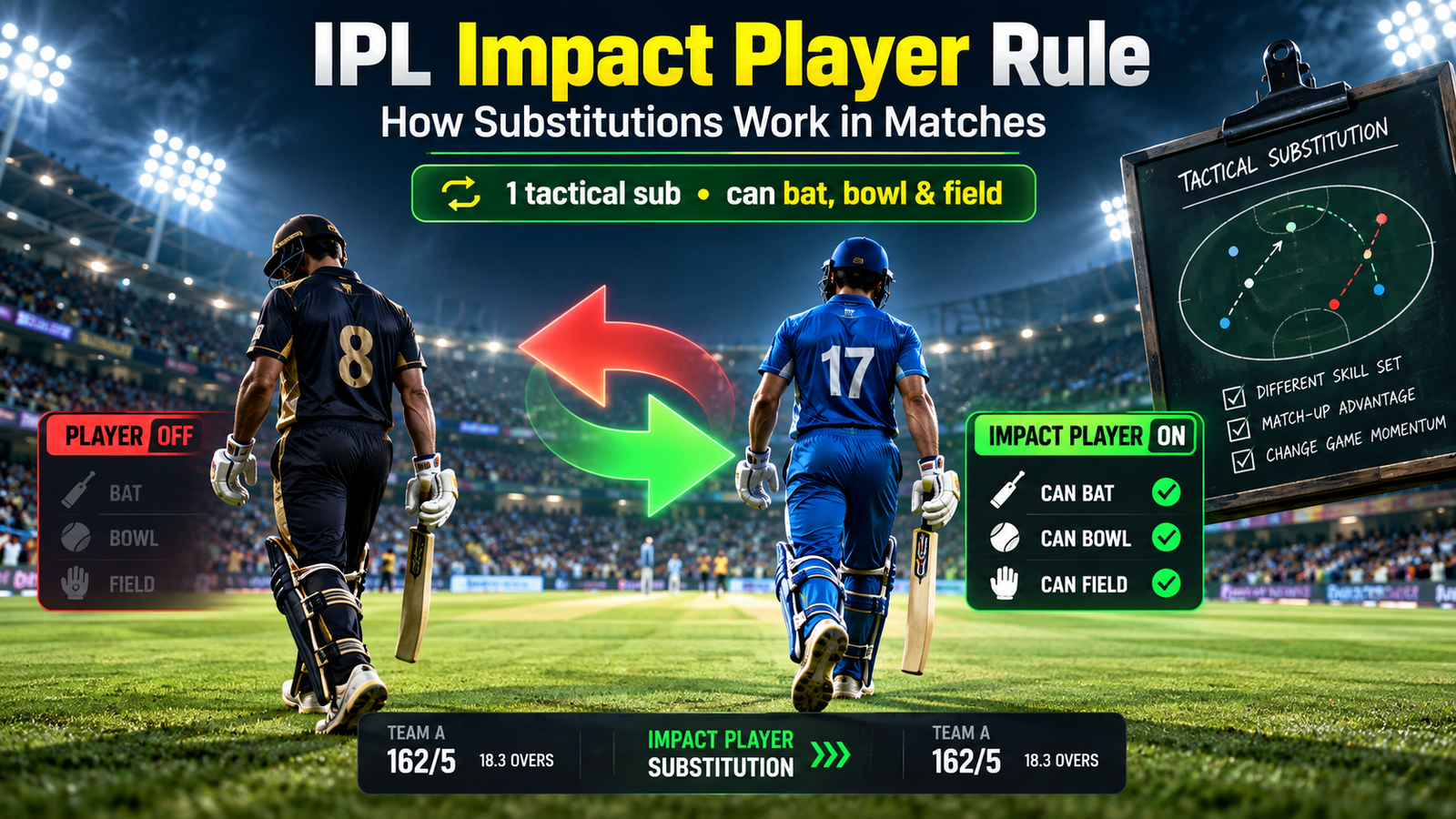
The IPL Impact Player rule lets each team replace one member of its starting XI with a named substitute who can fully participate in the match. Unlike a conventional substitute fielder, the incoming player can bat, bowl and field. The provision gives captains a way to adapt their combination to the state of the game, whether that means adding a specialist batter during a chase or a bowler for a particular phase.
What the IPL Impact Player Rule Means
Introduced in IPL 2023, the rule permits one tactical substitution per team in a match. Before the toss, teams name their playing XI along with five substitutes. Any one player from that group of substitutes may be used as the Impact Player, subject to the overseas-player conditions.
The player replaced by the Impact Player cannot return to the game. That is an important distinction: it is a permanent switch rather than a temporary fielding change. Once a side has used its one Impact Player, it cannot make another tactical replacement under this rule.
The rule differs significantly from ordinary cricket substitutions. A regular substitute fielder can take the field for an injured player but cannot ordinarily bowl or bat. An Impact Player, on the other hand, becomes a full participant. That makes the decision more consequential, as teams must judge both the immediate requirement and the possible demands of the rest of the match.
When Can a Team Introduce the Impact Player?
Captains cannot make the substitution at any random moment. The change must happen during a recognised natural break in play. The permitted points are before the start of an innings, at the end of an over, after a wicket falls, or when a batter retires.
This timing gives teams considerable flexibility without allowing them to interrupt an over simply to create a favourable match-up. A side can wait to see the conditions, the target or the progress of an innings before deciding whether a batting or bowling specialist would be more valuable.
The Mid-Over Bowling Restriction
There is one practical limitation when the bowling side introduces its Impact Player after a wicket falls or a batter retires in the middle of an over. The substitute cannot bowl the remaining deliveries of that over.
For example, if a wicket falls after three balls and the fielding captain brings on a new bowler as the Impact Player, another eligible bowler must complete the final three balls. The Impact Player may bowl later, once the over has ended. This prevents a captain from using a mid-over substitution solely to alter the bowler immediately.
Who Can Be an Impact Player?
The overseas-player rule is central to understanding the system. If a team names four overseas players in its starting XI, its Impact Player must be Indian. This preserves the IPL’s long-standing limit of four overseas players in a team during a match.
If a side starts with three or fewer overseas players, it can use an overseas player as its Impact Player, provided that player was included among the named substitutes before the toss. In practical terms, a team can begin with an extra Indian player and retain the option of bringing in a foreign specialist later.
This condition has made the bench particularly important. Teams do not merely select substitutes as cover for injuries or fielding duties; they can plan for contrasting situations. A domestic batter may be available for a chase, while an overseas fast bowler or spinner could be held back if the initial XI contains fewer than four overseas players.
For readers following team combinations, scorecards and tactical decisions, resources such as thecricscope.com can help place individual selections within the wider match context. The key detail remains that the Impact Player must be from the substitutes named before the toss; a player outside that group cannot be introduced later.
Batting Rights and the Eleven-Player Limit
The Impact Player can bat at any position in the order. However, the rule does not create a 12-player batting line-up. Only 11 players can bat in an innings.
If a team sends in a batting Impact Player after one of its original batters has already been dismissed or retired, somebody else who has not batted will miss out. In many cases, that might be a specialist bowler at the lower end of the order. The substitution improves the available batting resources but does not allow a twelfth wicket to fall.
This detail explains why teams often make the call based on the innings situation. A side chasing a demanding target may feel that an additional recognised batter is worth more than the limited batting contribution expected from a bowler. Conversely, a team defending a total may favour an extra bowling option rather than retain a batter who is no longer needed.
Bowling Rights and Tactical Uses
An Impact Player is allowed to bowl a full quota of four overs, irrespective of how many overs the player being replaced has delivered. This is one of the rule’s most significant tactical effects.
A captain can therefore use a bowler for one phase of an innings and later replace that player with another bowler whose skills fit a different phase. A new-ball specialist, for instance, could be substituted after completing work in the powerplay, allowing a death-overs option to bowl later in the innings.
The substitute’s four overs do not combine with the replaced player’s overs as a shared individual quota. Each is treated according to their own entitlement. Even so, teams must still manage the innings within the usual limit of 20 overs and deploy enough bowlers to complete them.
How the Rule Shapes Selection
The Impact Player rule has encouraged teams to think in terms of flexible roles. Rather than selecting an XI that must cover every likely situation by itself, a side can start with a combination suited to the first innings and keep a specialist in reserve.
A team bowling first may begin with a stronger bowling group, then introduce an additional batter during the chase. A team batting first might make the reverse calculation: maximise its scoring potential early and later add a bowler to defend the target. Conditions, toss decisions and the opposition’s line-up can all influence the choice.
The system also creates opportunities for Indian domestic players because an Indian Impact Player is the only option for teams that start with four overseas cricketers. A player who may not fit every starting XI can still have a clearly defined role from the bench, requiring readiness to perform at a specific moment.
Key IPL Impact Player Examples
Tushar Deshpande of Chennai Super Kings became the first Impact Player in IPL history on March 31, 2023. He replaced Ambati Rayudu in the IPL 2023 season opener against Gujarat Titans at the Narendra Modi Stadium in Ahmedabad. The moment established how quickly teams were willing to use the new option in live competition.
IPL 2023 also showed that the rule was not restricted to bowlers. Kolkata Knight Riders’ Venkatesh Iyer and Rajasthan Royals’ Dhruv Jurel were among players noted for making an impact after being used in this capacity. Their examples underlined that the substitute can be chosen for batting, bowling or broader match requirements rather than one fixed role.
Chennai Super Kings, who won IPL 2023, were among the sides that used the rule as a tactical device across the season. The wider lesson was simple: the best decision was not always to name the strongest possible conventional XI, but to preserve an option that matched the game’s likely direction.
Why the Rule Has Prompted Debate
Supporters view the Impact Player as an added layer of T20 strategy. It rewards planning, makes bench strength more meaningful and lets captains react to circumstances. It may also give emerging players a route into significant match situations without requiring them to be selected in every starting XI.
Critics have raised concerns about its effect on all-rounders. If teams can use a specialist batter and later bring in a specialist bowler, there can be less incentive to pick players who contribute in both disciplines. The rule can also make batting line-ups appear deeper, because a side knows it has another specialist available if required.
MS Dhoni has said the extra batter is not the only reason for high scores; he pointed to the confidence and more aggressive mindset that can come from knowing there is additional batting cover. That observation captures the broader influence of the rule: its value can begin before the substitute actually walks onto the field.
Conclusion
The IPL Impact Player rule is a one-time tactical substitution that can alter how a team bats, bowls and builds its starting XI. Understanding the timing windows, overseas restriction and four-over bowling allowance makes captaincy decisions easier to follow. More than a bench option, the Impact Player has become a strategic choice that can shape the direction of an entire T20 match.